
Waterproof it before you finish it.
Most Toronto basements do not need an excavator before they can be finished. They need a diagnosis: where the water gets in, then the right fix written into the finishing contract. We build waterproofing as part of a finished basement, with a sump and backwater valve where the house calls for them, and the City of Toronto now covers up to $6,650 of that protective work.
Why the water gets in
The soil under most of the GTA is clay. It swells when it is wet and shrinks when it is dry, and every cycle leans on the foundation wall. Add a winter of freeze and thaw, a weeping tile that was laid when the house was built, and a lawn that has settled toward the house instead of away from it, and water has three ways in: through cracks in the wall, up through the floor where the footing drain has clogged, or back up the floor drain when the street sewer surcharges in a storm.
Three problems, three fixes. A contractor who quotes one product for all three has not looked at your basement.
Interior or exterior
An exterior system is the honest fix. You dig to the footing, clean the wall, apply a membrane and a drainage board, replace the weeping tile and backfill. Water never touches the inside face of the wall. It is also the expensive one, and it takes the garden, the walkway and sometimes the neighbour's goodwill with it.
An interior system accepts that some water will reach the wall and manages it. A channel is cut into the slab along the footing, a drainage membrane carries the wall seepage down into it, and the channel runs to a sump pit with a pump. For a basement that is about to be finished, this is usually the right call: the work happens inside, the floor goes back over it, and the pump does its job under the stairs for the next thirty years.
We recommend exterior work when the weeping tile has failed outright, when water is coming through under pressure, or when the grading has to be rebuilt anyway. Otherwise an interior system with a battery-backed pump handles the majority of what we see.
What we check before framing
Every basement we finish starts with the water, not the layout. We look for the tide line of efflorescence on the block, hairline cracks that have been painted over, a floor drain that has not been tested in years, and downspouts that still empty beside the foundation. We check whether the sump pit, if there is one, is deep enough and covered, and whether the pump has a backup. Then we walk the outside and read the grade.
If the house needs a backwater valve, that is a plumbing permit and an inspection, and it goes on the quote as its own line. Finishing over an unresolved leak is the single most common reason a basement renovation fails in year three: mould behind drywall, a vinyl floor that lifts, and a warranty argument nobody wins.
The floor is part of the system
A dry wall does not help if the slab sweats. Concrete wicks moisture from the ground below it year round, which is why we install a DRICORE R+ subfloor on every basement instead of laying vinyl plank straight on the concrete. The raised panel gives moisture a path to the drain and keeps the finished floor off the cold slab. We wrote a whole post on why most contractors skip the subfloor, and why we do not.
The September 2026 storm dropped more than 100 millimetres on parts of Toronto in a few hours. Basements that had a working sump, a backwater valve and a raised subfloor dried out. Basements with vinyl glued to the slab did not. If yours took on water this year, start with our flooded basement guide.
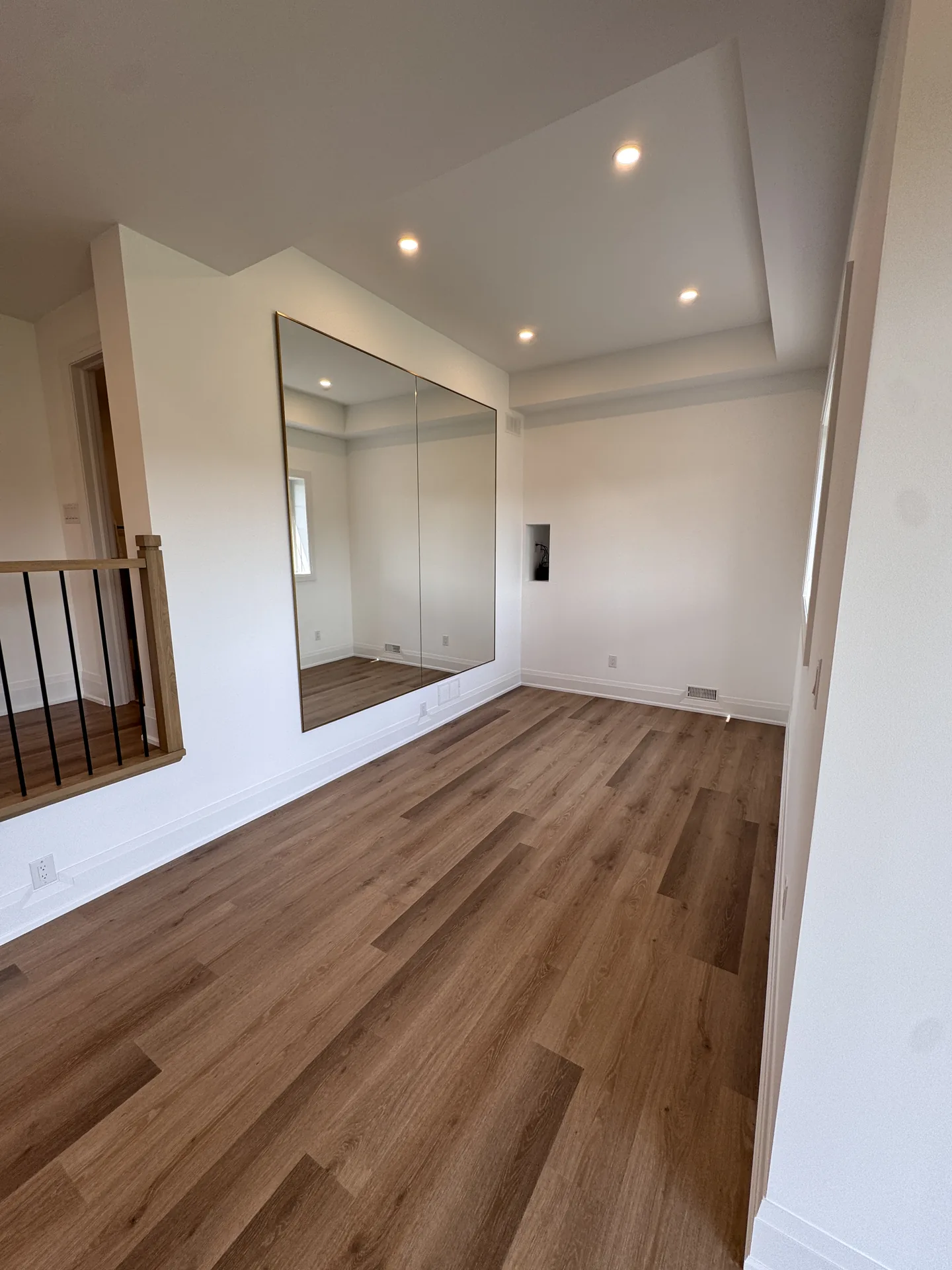
Dry first. Then this.
A finished Desire basement: vinyl plank over a DRICORE R+ subfloor, the sump under the stairs, nothing on the wall but paint. The waterproofing is invisible because it was done before the first stud went up.
See more of what the finish looks like in the project gallery.
The City pays for part of it.
Toronto expanded its subsidy on May 1, 2026. If you own a single family home, duplex, triplex or fourplex in the city, the program pays 80% of the invoice for each item below, up to the caps shown, to a lifetime maximum of $6,650 per property for work completed on or after November 12, 2025.
| Protective work | City pays |
|---|---|
| Home plumbing assessment by a licensed plumberOne time, on the City's form | $500 |
| Backwater valve with alarmUp to two devices, building permit and inspection required | $1,600per device |
| Sump pump with alarmOne device | $2,250 |
| Sump pump battery backupItemized separately on the invoice | $300 |
| Weeping tile severance and cappingDisconnecting the foundation drain from the City sewer | $400 |
| Lifetime maximum per property | $6,650 |
Source: City of Toronto, Basement Flooding Protection Subsidy Program, page modified June 18, 2026. Downspouts must already be disconnected, the contractor must hold a City of Toronto business licence, and you apply within two years of the work. Outside Toronto the rules differ; our 2026 rebate guide covers the GTA city by city.
Water finds the detail somebody skipped. We would rather find it first, with the floor still open.
Desire Basements, since 2017What it costs inside a finish
Every basement is priced from the same quote sheet, line by line: a 1,000 sq ft basement with a three-piece bathroom comes to about $67,800 before HST, and the price per square foot falls as the basement grows because the permit, bin, breakers, stairs and bathroom cost the same at any size. Waterproofing is added to that sheet as its own lines, so you can see the sump, the valve and the membrane priced separately from the drywall. Use the basement cost calculator to price the finish, then bring us the water.
A real number comes from a site visit, and the itemized quote follows within 24 to 48 hours.
Waterproofing we install as part of the finish carries the same lifetime workmanship warranty as the framing above it. We do not sell standalone emergency waterproofing; if the basement is staying unfinished, a waterproofing specialist is the better call, and we will say so on the visit.
Before the first stud.
Do I need to waterproof before finishing a basement in Toronto?
Only if the basement has a water problem, and you find that out before framing, not after. We check the walls, floor drain, sump and grading on the first visit. A dry basement with sound weeping tile gets a DRICORE R+ subfloor and vapour barrier, which every Desire basement has. A basement with seepage gets an interior system, a sump with battery backup and, where the house needs it, a backwater valve, all priced as separate lines on the quote.
Is interior or exterior waterproofing better?
Exterior stops water at the source and is the right answer when the weeping tile has failed or water is coming through under pressure. Interior manages water that reaches the wall and is usually the right answer for a basement that is about to be finished, because the work happens inside and the finished floor goes back over it.
How much does the City of Toronto subsidy cover?
Up to $6,650 per property for work completed on or after November 12, 2025: 80% of the invoice up to $1,600 per backwater valve (two allowed), $2,250 for a sump pump, $300 for its battery backup, $500 for a plumbing assessment and $400 for weeping tile severance. Source: City of Toronto, Basement Flooding Protection Subsidy Program, 2026. The backwater valve needs a building permit and an inspection before it is covered.
Does a sump pump need a permit?
In Toronto the backwater valve does; the City will not pay the subsidy on a valve that was covered up before inspection. New plumbing of any kind inside a basement finish needs a permit under the Building Code, and Toronto charges $23.20 per fixture on a single family dwelling plus the $214.79 minimum. Source: City of Toronto, Building Permit Fees, effective January 1, 2026.
Does your lifetime workmanship warranty cover the waterproofing?
Yes, when we install it as part of the finish. The membrane, the drainage channel, the sump installation and the subfloor are our workmanship and carry the same lifetime workmanship warranty as the rest of the basement. Pumps and valves are manufactured products and carry their makers' warranties, which we hand over with the permit sign off.
Bring us the wet one.
A free visit at your home, an honest read on where the water comes from, a 3D design of the finished space, and a quote with every line on it.