A basement bathroom drains by gravity, through a sewage ejector or with an upflush toilet. How to tell which one your house needs, what each adds to the cost, and the permit and backwater valve rules that apply.
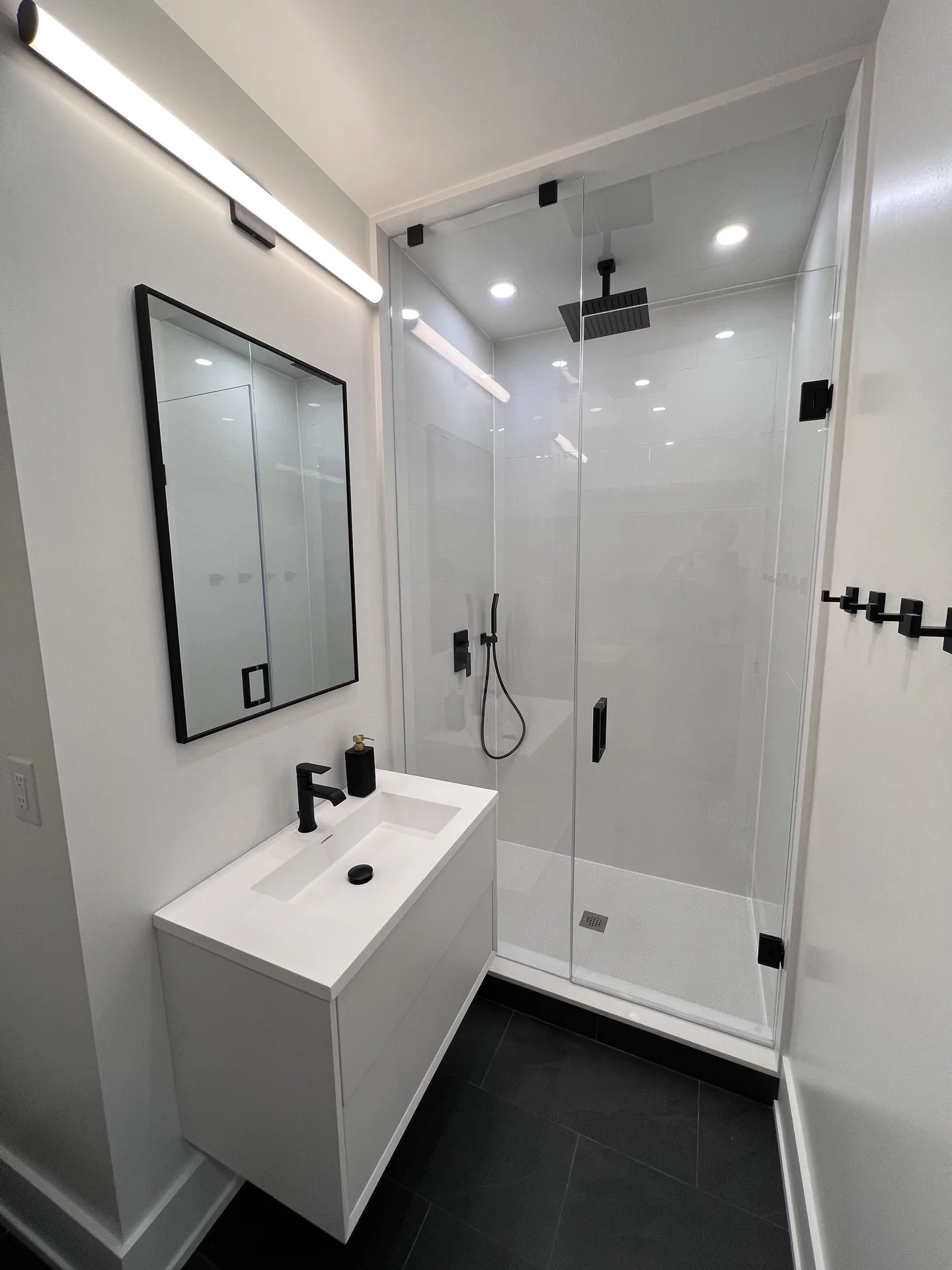
A basement bathroom in the GTA drains one of three ways. It can run by gravity into a rough-in under the slab, it can be pumped up to the main line by a sewage ejector, or it can use an upflush toilet that grinds waste and pushes it through a narrow pipe. Gravity is the cheapest and quietest. An ejector is the right answer when your fixtures sit below the sewer line. An upflush toilet solves one specific problem and creates a few others. Which one you get depends on a single fact about your house, and you can find it out before you spend anything.
Waste only drains by gravity if the pipe can fall the whole way to the sewer connection. In a house with a high basement slab and a deep sewer lateral, that is easy. In a house on a low lot, in many older Toronto and Etobicoke homes, and in basements that have been underpinned to gain ceiling height, the floor can end up at or below the point where the building drain leaves the house. Then the pipe has nowhere to fall to.
Before we draw a bathroom layout, we check whether a rough-in exists and whether the house drains by gravity or needs an ejector. Everything about the layout, the price and the schedule follows from that answer. If you are also thinking about lowering the floor, read how underpinning cost in Toronto works first, because it changes this answer.
A rough-in is a set of capped drain and vent stubs left under the slab, usually near the main stack. When the builder left one, the plumber connects to it and the bathroom goes in where the stubs are. This is the cheapest and quietest version, with no moving parts to fail.
The catch is that many basements have no rough-in, or have one in the wrong place. Then the slab has to be cut, new lines run to the main drain, and the floor poured again. On our basement bathroom cost guide that adds about $3,000 to $6,000 to the bathroom. It is dusty and loud for a few days, and it is still usually the better long-term choice than a pump if the house allows gravity drainage at all.
An ejector is a sealed, vented basin set into the floor. Waste from the bathroom drains into it, and a pump lifts it up to the main line. It is what makes a bathroom possible when the fixtures sit below the sewer, and it adds roughly $2,000 to $4,000 on top of the bathroom itself.
It is also a mechanical part, and mechanical parts wear out. Pumps have a service life, so the honest question is not whether it will ever need attention but how easy it will be to get at when it does. Ask where the basin lid sits, whether it is under a finished surface, and whether the system has a high-water alarm. A basin buried under tile with no access is a future problem sold as a finished bathroom. Insist on a lid a plumber can reach without demolishing anything.
An upflush unit sits behind or beside a toilet, macerates the waste and pumps it through a small-diameter pipe to the nearest drain stack. Because it needs no cut in the slab, it can turn a storage corner into a powder room quickly. Macerating toilet systems are covered by a joint ASME and CSA standard, A112.3.4 / CSA B45.9, so these are not novelty products.
The trade-offs are practical. The unit makes noise every time it runs, it is another motor to maintain, and it is a poor match for a bathroom meant to feel like a spa. Local plumbing inspectors also have the final say on whether a given unit is acceptable for your layout, so ask before you buy one rather than after it is installed. For a single guest powder room it can make sense. For the main bathroom of a basement we are building around, we would rather solve the drainage properly.
A bathroom is new plumbing, and new plumbing means a permit. In Toronto the permit exemption for basement finishing only applies when there is no structural change, no new plumbing and no second unit, so a bathroom is outside it. Our GTA basement permit guide lists the plumbing fixture fees by municipality. The plumbing is inspected in the open trench before the slab is closed, which is why a bathroom job has a hard stop in the schedule that a paint-and-flooring job does not.
This is also the moment to think about the backwater valve, because the same trench is open. Toronto's Basement Flooding Protection Subsidy pays up to 80 per cent of the invoiced cost, to a maximum of $1,600 per device and two devices, for work completed on or after November 12, 2025. It requires a building permit, an inspection before the valve is covered, and an installer holding a City of Toronto business licence. Other municipalities run their own programs, so check yours. Our flooding rebates guide and waterproofing guide cover the rest of the picture.
Start with the drain, not the tile. If a rough-in exists and the house drains by gravity, use it. If the fixtures sit below the sewer line, plan for an ejector from day one and budget the $2,000 to $4,000 up front rather than discovering it at the rough-in inspection. If you only want a powder room and cutting the slab does not make sense, an upflush unit is worth pricing against it. Every one of these paths ends up in the same quote, line by line, so you can compare them before anything is built. Our bathroom renovation service and the GTA basement cost report show how those lines are put together, and monthly financing is available if you want to spread the cost.
Yes. A bathroom is new plumbing, which puts it outside the exemption Toronto gives to basement finishing with no structural change, no new plumbing and no second unit. Vaughan requires a permit for any new or relocated plumbing fixture, and the plumbing is inspected before the slab is closed.
On our bathroom cost guide an ejector adds roughly $2,000 to $4,000 when the fixtures sit below the sewer line. That covers the sealed basin, the pump and the venting, and it sits on top of the bathroom itself.
Sometimes. If a capped rough-in already exists under the slab, the plumber connects to it and nothing is cut. An upflush toilet also avoids the slab, with trade-offs. Running new drain lines to the main drain means cutting and re-pouring the floor, which adds roughly $3,000 to $6,000.
Macerating toilet systems are covered by a joint ASME and CSA standard (A112.3.4 / CSA B45.9). Whether a particular unit is accepted for your layout is up to your municipal plumbing inspector, so ask before you buy one.
Toronto's Basement Flooding Protection Subsidy covers up to 80 per cent of the invoiced cost, to a maximum of $1,600 per device and two devices, for work completed on or after November 12, 2025. A building permit and inspection are required, and the installer needs a City of Toronto business licence.
If you are not sure which of the three your house needs, we will check the rough-in and the sewer depth at a free in-home consultation and show you the bathroom in a free 3D design before any slab is cut. Homeowners in Toronto and across the GTA see the drainage option priced as its own line on the quote.

Kam walks the space, draws it in 3D and sends an itemized estimate within 24 to 48 hours. No allowance lines, no surprises.
Get a Free Estimate