Pool rooms, gaming setups and the office next door: how we plan basement game rooms in the GTA, with the measurements and costs that decide them.
A pool table needs more room than the room. An 8-foot table is 4.5 by 9 feet, but the cue is nearly 5 feet long, so the space around it has to be close to 17 by 14 feet before anyone can take a shot from every side without hitting a wall. That measurement decides more game rooms than any paint colour. After 400+ basements across the GTA since 2017, the game rooms that get used every week share three things: the table or the screen fits with room to move, the lighting is built for the activity, and the room still works for the rest of the family when nobody is playing.
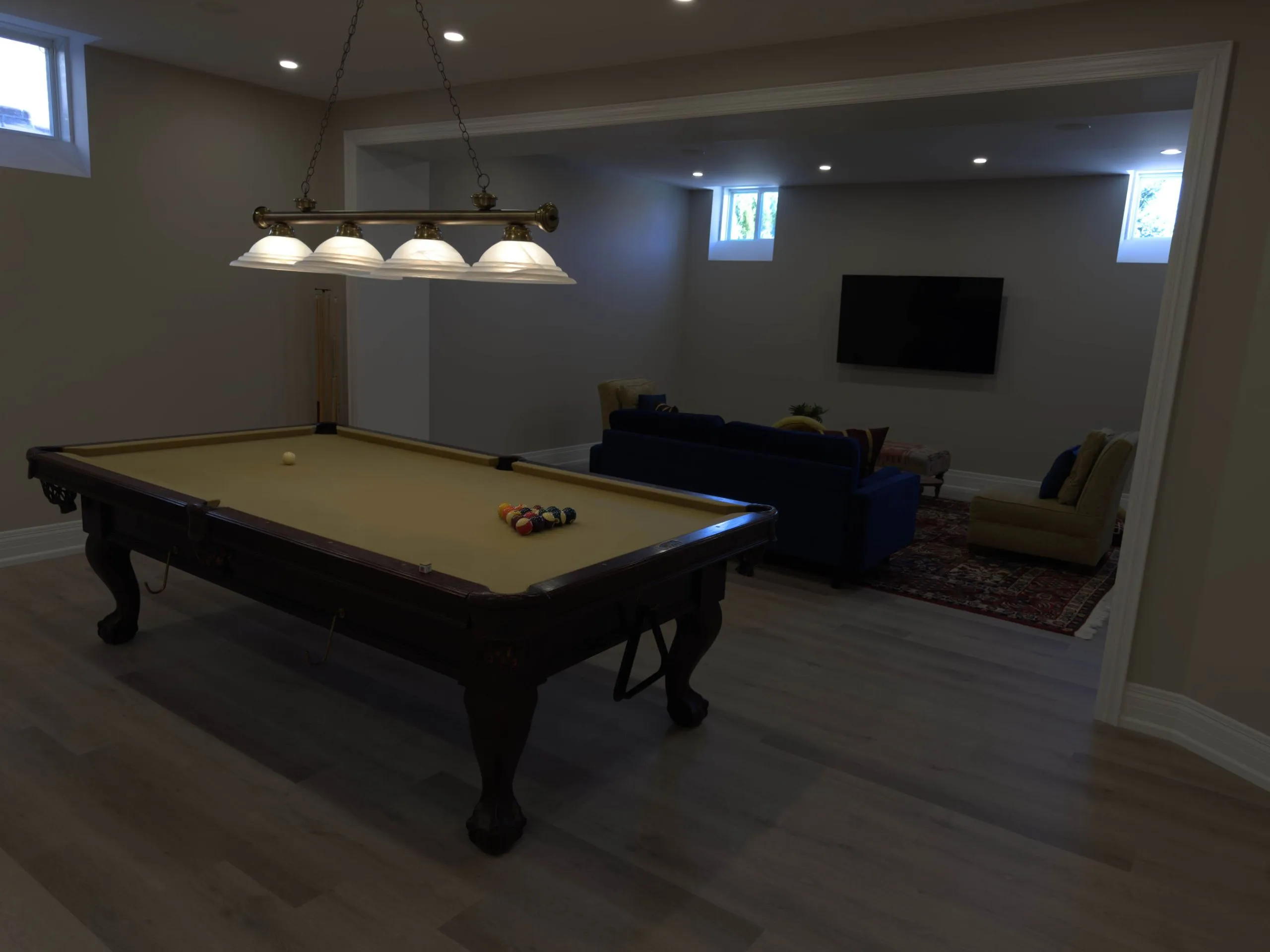
Every game room is designed backwards from one object. A pool table, a gaming setup, a ping-pong table, a poker table, a golf simulator. Pick it first, because it sets the footprint. The pool room in the photo above works because the table sits in its own zone under a three-shade light, with the sofa and TV in the next bay through a wide cased opening. Long and narrow basements want that two-bay split; square rooms put the table in the middle and the seating on the walls.
Gaming rooms have the opposite problem. They need less floor and more wall. A desk deep enough for two monitors, cable management behind it, a slat or panel wall to take the acoustic edge off, and enough outlets that nobody runs a power bar across the floor. We built a media room with a projector screen at one end and two desk workstations at the other for a family that games and watches together; the same room does homework on weeknights. That double duty is the difference between a room the kids outgrow and a room that outlasts them.
Pot lights on their own make a game room feel like a hallway. Over a pool table the fixture belongs 32 to 36 inches above the felt, long enough to light the whole surface without a shadow from the cue. For a gaming desk, indirect light behind the monitors does more than anything overhead, and an LED cove around a dropped ceiling perimeter gives you a dimmable setting for movie nights. Our basement ceiling guide covers the bulkhead and height rules that decide what you can drop and where.
Put the lights on separate dimmers by zone. It costs a few hundred dollars at rough-in and it is the cheapest thing that makes a game room feel designed.
If the room has a TV, the wall behind it is where the money shows. A wood slat wall with LED strips glowing between the slats, a full-height media unit with lit niches for consoles and controllers, or a dark panel wall that swallows the glare. In Markham we built a black media unit with LED shelving that turns the consoles into part of the design instead of a pile of boxes; in Vaughan, a navy unit with brass hardware does the same job in a family room. The feature wall guide shows what each of these costs.
Most people asking for a game room also want somewhere to work. The two share a basement well as long as they do not share a wall with the theatre. We tuck offices behind a glass partition or a black-framed glass barn door so the space stays bright and connected but the noise stays out. A custom desk unit with walnut slats and lit shelving, or blue built-in cabinetry with a desk run, makes the office a room you chose rather than a corner you ended up with. If the office needs to be quiet during game night, insulate the partition wall with mineral wool and hang a solid-core door. Small line on the quote, large one in daily life.
Every game room drifts toward the bar. A small wet bar with a sink and a bar fridge keeps the game going without a trip upstairs, and it is the feature guests mention. A full wet bar is priced as its own lines on the quote, with the rough-ins at $1,800 and the millwork and stone chosen with you; a beverage fridge in a run of cabinets is a fraction of that. Our cool basement ideas post has the bars we get asked to repeat most.
The room itself is priced like the rest of the basement. Every basement is priced from the same quote sheet, line by line: a 1,000 sq ft basement with a three-piece bathroom comes to about $67,800 before HST, and the price per square foot falls as the basement grows because the permit, bin, breakers, stairs and bathroom cost the same at any size. The game room adds its equipment and its wall: a pool table is your purchase, a media wall or desk unit is millwork we design and build, and a theatre setup is priced as its own lines if the game room doubles as the movie room. Start with the basement cost calculator, and financing spreads the project into monthly payments.
One honest caution about pool tables. They weigh 400 to 1,000 pounds and they are slate-bed tables, so they go in after the flooring and they do not move afterward. Confirm stair and door widths before you buy one, and put the outlets and the light exactly where the table will live.
Every project starts with a free in-home consultation and free 3D design, so you see the table, the screen wall and the desk in your own basement before anything is ordered. Bring the game you want to play. We will tell you whether the room can hold it.
Plan on about 17 by 14 feet for a standard 8-foot table, which allows a full cue stroke on every side. A 7-foot table can work in roughly 16 by 13 feet. Measure the clear space between finished walls and columns, not the bare concrete.
Yes, and it is one of our most common layouts. Separate them with a glass partition or a solid-core door, insulate the shared wall, and give each its own lighting circuit. The office stays quiet on game night and the basement stays bright.
The finished space is priced from the same quote sheet as every basement we build: a 1,000 sq ft basement with a three-piece bathroom comes to about $67,800 before HST, and the price per square foot falls as the basement grows. Equipment is on top: a pool table is your purchase, a custom media wall or desk unit is built to order, and a theatre setup is priced as its own lines.
A well-finished basement adds usable square footage, and that is what buyers pay for. A flexible game room that can become a family room or office keeps the value; a room built around one built-in feature only some buyers want does not. We design them to convert.

Kam walks the space, draws it in 3D and sends an itemized estimate within 24 to 48 hours. No allowance lines, no surprises.
Get a Free Estimate